
ABSTRACT
The Winter War takes place in The Ivory Isles during the late winter of 872 A.D to the early winter 873 A.D (After Death of Graen), where the realms are predominantly under two opposing banners: The Kingdom of Camelon to the south, under the rule of House Montrose (their sigil is the green banner of the white lion), and the Kingdom of Corumand to the north, under the rule of House Lachlann ( their sigil is the orange banner of the black wyvern), leading to a decisive change to the way of life across The Ivory Isles.
In the mid 800’s A.D Camelon had rallied behind the calling of the The Voice of the Creator for a holy crusade against the heretical realms across the Polar Sea that threatened the Graenician faith with their sorcerer ways. They were one of many lands that joined the fight, and were victorious in many campaigns, however the crusade itself ultimately resulted in defeat. The surviving soldiers returned home to rest, be thankful that they had survived and fought in the name of The Creator, and spend their lives with their families by their hearths. But little did they know that they would return home with the shadow of war looming behind them.
Though Camelon is a faithful, chivalrous kingdom, and had fought and bled in the crusade, the same could not be said for their neighbouring kingdom to the north: Corumand. Corumand is a dark contrast to Camelon. Though they too follow a feudalistic regime and share many traditions as their southern neighbours, they are plagued with corruption, lawlessness and turmoil. Blood feuds between noble and royal families, outlaws and monsters infest the wilds and harry settlements, cultists who worship things that range from the strange to the outright diabolical run rampant in the vast wilds or fester in the shadows of humble communities.
Corumand had forever been a thorn in Camelon’s side, especially since that land had once belonged to Camelon centuries past, and so it’s existence was a passive reminder of what could become of their fair land, should they falter in faith and chivalry. Similarly, Corumand forever kept it’s guard against the southern neighbour. Preparing for the day Camelon may muster their courage to attempt to reclaim their supposed rightful land and subjects back to the fold of the ruling family of Camelon – House Montrose. However, though the two kingdoms have provoked each other with border raids and blockades, no war ever sprung between them. Until it did.
Though a decade or so had passed since the end of the crusade (which was now known as the Red Crusade, after the colossal mess of a battle at Polaris), Camelon was still weak, as the labour force had thinned, an unfortunate series of droughts and endemic plagues spread across the seasons, leading to a rise in poverty and and a drop in public order. And what’s more, the fighting population was still ill equipped to fend off the rising incursions from bandits and monsters.
In 870 A.D King Lavin Montrose passed away and was succeeded by his son (and only male heir), Tarth. Tarth had grown up with bittersweet stories of his father’s time in the crusades, and on how close they had been to victory. Tales of Camelon’s old glory, peace, piety and humble way of life stuck with Tarth. But he had grown up to the constant strife of his subjects and the scheming of the discontented royal court.
When he became king, he was known to wander the halls of his forefathers, observing the tapestries of old and walking in disguise through the old parts of Camelon Castle. His sadness gradually hardened to anger. In his vengeful grief, he decided what the nation needed was a distraction from their every day struggle. Something a mummers play or a pitiful tourney could not do. And in 872 A.D, Corumand gave him just that.
In the winter of 872 A.D, raiders from Arafax – the direct borderlands to Camelon – harried the fishing town of Mariburn. The attack was the perfect reason for King Tarth to raise the banners of the White Lion. Promise of an end to the poverty that was racing the land to destitution; for both peasant and nobility, ignited a new fire in King Tarth’s subjects and court.
He started with the capture of Southumbria – a pivotal source of gold, silver and wheat for Corumand’s economy. And from there, the war officially began, with the surge of Camelon swiftly conquering Umbria, Dalfarne, Harburgh, Noroshire, Berchester and Arafax all within three months.
Corumand was taken aback with the sudden and strategically efficient conquest of Camelon, and it’s people, fearing to lose their way of life to their southern rivals, quickly regrouped and counterattacked. Camelon had an excellent cavalry and stalwart infantry that could break enemy lines with ease. In Corumand, they had excellent archers and shock infantry; the militias making for effective guerilla tactics that could harry and ambush their enemy. Camelon’s first defeat was at Harburgh Keep, when the Duchess of Harburgh rallied her (now deceased) brother’s surviving forces and drove the occupants of her family’s ancestral home out. Moreover, the northern lords of Lothian took to their fleets and blockaded many of Camelon’s ports in the south or sacked coastal settlements, causing chaos in King Tarth’s kingdom.
Within five months The Ivory Isles had spiralled into utter chaos, pulling in mercenaries from elsewhere that only fuelled the flames of battle. King Tarth had been taught well by his tutors and father. In the early winter of 873 A.D, what remained under Corumand’s dominion were Lothian, Wyvern’s Tor, the isle of Armorica, Lym and Runestone. John of House Lachlann – the King of Corumand (or what was left of it), witnessed the combined armies of Camelon and his new vassals marching forth to redoubt to where he was regrouping his knights, Forworth Castle. And at it’s helm, the fair king Tarth donned in shimmering armour atop his white horse.
A siege was about to begin. But John would not stand alone in this deciding moment of history. King Tarth had not just made an enemy of the ruling lords of Corumand, but also – unknowingly or not – he had angered more ancient, stranger things. The druids who dwelt freely within the land who found themselves scourged by the Grinning Knights, and the gnomes, elves, troglodytes and other creatures that dwelt within the deep wilds of the land had also found their homelands attacked. Should Camelon succeed, their ways of life would also be greatly affected, if not outright eradicated.
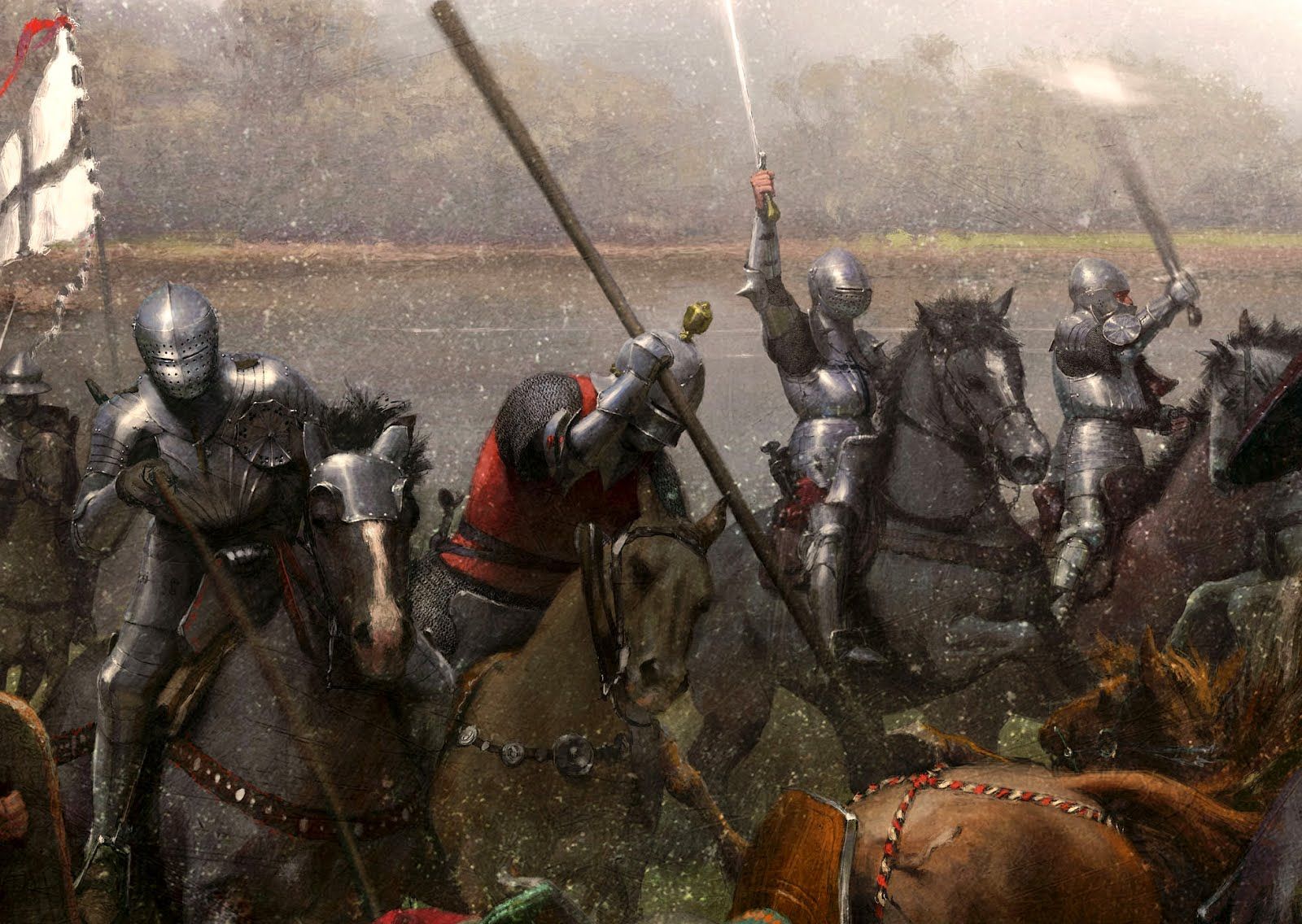
The truth to how aid from afar came to King John in his horu of need is obscure, but what is known that on a sunny Sorday dawn, the Serpent Gate of Forworth Castle opened. King John, donned in red armour beneath an orange tabard, riding atop his black steed and holding his sword aloft. Besides his horde of knights and soldiers, came forth a union of druids and gnomes – even some elves and troglodytes had come to fight for the Wyvern King.
King John was the avatar everything King Tarth opposed; monsters, magicians, cultists and faux knights. Rallying speeches were made, and the horns of battle were sounded before they died beneath the deafening roar of the two armies as they charged.
The battle was fought until the early afternoon, as the battlefield became sodden with rain and hail. Both Kings had been un-horsed and eventually, they met each other amidst the chaos. Their battle was short, however. After less than a minute of duelling, King John drove his sword into King Tarth’s helm, before striking again to cleave the king’s head from his shoulders, and holding it aloft. The morale of the Camelon knights broke and wavered, and before long they were in full retreat.
Corumand won. But it did not end there.
With the sole male heir of Camelon slain, and with the subsequent exodus of his family from Camelon Castle after hired assassins infiltrated their court, the remaining Houses once loyal to Camelon quickly surrendered to Corumand as King John began a crusade of his own to take back his rightful lands. Those Houses were wise, for Corumand – it’s morale bolstered by vengeance against Camelon, descend to the south bringing ruin to all who oppose the banner of Corumand. The lords of Camelon bend the knee to King John and become part of the yoke of Corumand. With this comes the dissolving of the Grinning Knights, and the colonisations of druids, elves and other creatures.
In the late winter of 873 A.D the last remnants of old Camelon is gone. From the isolated lands of Lothian to the sunny isle of Lyonesse is under the orange banner of House Lachlann. Though the land is united, it is a fragile unity indeed…
 FANTASY BOUND STUDIO